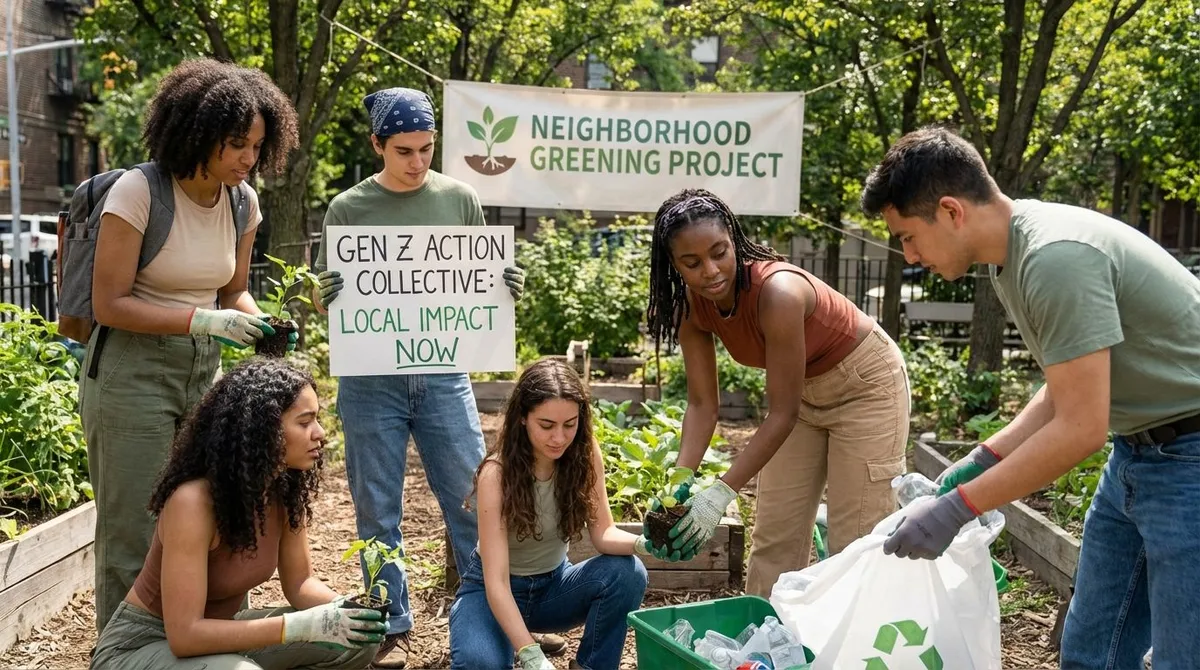
Generation Impact shows up when you build civic participation the way Gen Z already lives, socially connected, action-oriented, and rooted in local outcomes. You earn sustained engagement by lowering the “how do I start?” friction, then proving impact fast enough that people return.
You’re about to get a field-tested view of how Gen Z activists are redefining community engagement through volunteering, mutual support, peer-to-peer mobilization, and offline conversations that convert into measurable local work. You’ll also get practical ways to design programs, school partnerships, nonprofit roles, and local government opportunities that Gen Z actually uses. Expect clear numbers, grounded operating principles, and execution details you can apply immediately.
How Are Gen Z Activists Redefining Community Engagement Beyond Protests And Voting?
Start with the baseline: Gen Z cares deeply about community, then gets blocked by unclear entry points. In a national survey of 1,000 young people ages 14–22, 90% said they care about their communities, yet 37% said they don’t know how to start and 33% doubt they can make a difference.
That gap between intent and action explains the shift you’re seeing on the ground. Community engagement is moving away from “join the org, attend the monthly meeting, learn the rules,” toward participation that feels like a real social plan with a visible outcome. You’re seeing pop-up volunteer days, neighborhood cleanups, supply drives, peer tutoring, and local problem-solving sprints that require less institutional literacy and deliver faster feedback.
You should also notice how Gen Z treats engagement as a ladder, not a label. A person might start with one volunteering shift, then join a local group chat, then show up to a community meeting, then register friends to vote, then take a small leadership task. This stacking of actions matters operationally, since it rewards organizations that design multiple on-ramps instead of betting everything on one “big ask.”
The practical takeaway is simple: if your definition of engagement still begins and ends with formal politics, the pipeline will always look thin. If you define engagement as repeated local problem-solving with social glue, you’ll see participation grow, and you’ll keep it.
Is Gen Z Activism Mostly Online, Or Are They Showing Up Offline In Communities Too?
Gen Z uses digital channels as infrastructure, not as the finish line. The same national survey found the top ways young people say they get involved are talking about issues in person, 77%, and voting in elections, 73%. Commenting or debating online was lower, 46%, and “just like or share online” sat at 60%.
That pattern should change how you allocate budget and staff time. Social media still matters, yet it functions best as discovery, coordination, and storytelling. The conversion moment is still offline, a shift, a meeting, a distribution route, a canvass, a cleanup, a tutoring block, a school board agenda item, or a community space where people feel seen and useful.
Recent reporting reinforces this offline pull: many Gen Z volunteers describe volunteering as a way to unplug, gain real-life connection, and replace helpless scrolling with tangible contribution. Nonprofits also report increasing interest from young volunteers, and they’re adjusting by offering flexible roles and letting volunteers create content that recruits peers.
If you want more offline participation, stop treating offline as a “bonus.” Build it as the core product, then use digital to shorten the path from “saw it” to “showed up.”
What Causes Are Gen Z Most Engaged In, And What Actions Are They Actually Taking?
The most useful way to think about Gen Z participation is “what do they do,” not “what do they say.” CIRCLE’s post-2024 youth polling analysis reports that about 18% of youth attended demonstrations and 20% engaged in issue advocacy. It also reports 56% signed petitions, 41% boycotted products, and 34% tried to convince other youth to vote.
Those numbers matter because they show a wide spread across “light” and “heavy” actions. Petitions and boycotts are common, yet they are not the endpoint. When you offer a credible next step, many people take it, especially when the next step is social and local. The same CIRCLE analysis reports the most common civic behaviors are talking about politics, 66%, and helping peers and neighbors in need, 75%.
That last point should change how you measure engagement. If you only count attendance at formal events, you miss the majority of actual civic behavior that happens through peer networks. Helping a neighbor, organizing rides, sharing resources, coordinating childcare, or building a small support loop is civic capacity. When your program recognizes and channels those behaviors, you stop fighting the current and start riding it.
Operationally, the goal is to convert high-frequency actions, conversations and mutual help, into durable structures, recurring schedules, clear roles, and measurable local outcomes.
Why Do Some Gen Z People Care But Still Don’t Participate, And What Gets Them To Engage?
Three barriers keep showing up across credible research and day-to-day program work: unclear starting points, low confidence that effort matters, and real resource constraints. Citizens & Scholars found 37% don’t know how to start and 33% doubt they can make a difference.
Those barriers are not solved by better slogans or longer mission statements. They’re solved by product design: one clear first step, short time commitments, a welcoming human contact, and a fast proof loop. Citizens & Scholars also reports what pulls people in: 49% said friends getting involved motivates them, and 42% said they’ll get involved if they can see how their efforts make an impact.
CIRCLE adds a structural constraint your strategy must respect: financial struggle reduces participation across many civic actions, since participation often requires time, transportation, and unpaid labor. CIRCLE reports youth who struggle to meet basic needs are less active across a wide range of civic activities.
If you want participation that looks representative of your whole community, design for constraints. Cover transit, provide food, offer childcare options, build remote prep roles, pay youth leaders when possible, and schedule work in blocks that fit jobs and classes. Then publish outcomes so “my effort mattered” is never a guess.
What Does “Community Engagement” Look Like For Gen Z In Practice?
In practice, Gen Z community engagement looks like direct service paired with relationship-building. It’s more recurring than ceremonial. It’s more peer-led than hierarchy-led. It’s more likely to happen through a group chat and a calendar link than through a committee charter.
The data supports that “relational” shape. Citizens & Scholars found face-to-face conversation is a leading pathway into involvement, and friends are a leading motivator. Those two facts should push you toward formats that naturally produce connection: small teams, repeat shifts, shared tasks, and roles that let people bring a friend without needing permission.
At the same time, keep the work legible. You’ll keep Gen Z engaged when you define a deliverable that can be seen, counted, or verified. A weekly distribution schedule, a set number of households served, a measured cleanup route, a tutoring attendance target, a completed community survey with a published summary, a list of improvements adopted by a school or city office.
That’s the real shift: engagement is increasingly organized around tasks and outcomes that create trust, not around membership identity. If you treat that as a design requirement, you’ll stop losing people after the first event.
How Effective Is Gen Z Activism At Creating Measurable Local Impact?
Effectiveness comes down to whether the work links effort to outcome fast enough for people to feel momentum. Citizens & Scholars found 42% say they’ll get involved when they can see how their efforts make an impact. That number is a management directive. If impact is invisible for months, participation decays.
CIRCLE’s findings also show engagement channels reinforce each other instead of competing. Youth who voted in 2024 were much more active across other civic actions: volunteering, 48% vs 24%, serving in local leadership, 17% vs 5%, protesting, 22% vs 8%, and issue advocacy, 24% vs 6%. When you help someone take one meaningful action, you increase the odds they take another.
This is where program design often underperforms. Too many organizations ask for commitment before they offer proof. Flip that. Offer a one-hour role that produces a visible output, then invite the next step. Publish a weekly impact note, even if it’s simple: what got done, who benefited, what’s next, who to contact. Visibility is retention.
Also, separate “viral” from “valuable.” A post can travel fast and still produce no local output. Your operating system should treat storytelling as recruitment and accountability, then treat the offline deliverable as the goal.
How Can Schools, Nonprofits, And Local Governments Partner With Gen Z Without Losing Them?
Partnership succeeds when you remove friction, share real decision rights, and build roles that respect time and money constraints. Start with the clearest gap in the data: 37% don’t know how to start. If your organization requires a new person to decode five pages of program descriptions, you’re already losing them.
Local government and nonprofits can convert interest into participation by standardizing “start here” offers. One orientation per month, one QR-coded signup that leads to three roles, one human point of contact, and one consistent schedule. Add peer leadership early, since friends are a primary motivator. A youth lead who welcomes newcomers and assigns first tasks will outperform any generic volunteer inbox.
Then address barriers tied to resources. CIRCLE shows financial struggle correlates with lower participation across many civic actions. Cities and funders can act on that with paid youth roles, transit support, food at meetings, flexible scheduling, and microgrants for youth-led projects that produce local deliverables fast. Schools can help by offering credit-bearing civic projects with strong coaching and clear outputs, not performative “service hours.”
Murmuration’s research also points to a trust pattern you can use: Gen Z shows low confidence in institutions, yet higher trust in teachers, and a preference for community-related civic activities over overtly political ones. That means trusted adult connectors matter, and practical community work is often the strongest entry point. When you earn trust through useful local action, you gain permission to invite deeper participation later.
How You Build A Gen Z Engagement System That Sustains Participation
Run your engagement like an operating system with three layers: entry, belonging, and leadership. Entry is a single-step action that takes under 60 minutes to start and produces a visible output within a week. Belonging is a recurring cadence where people see the same faces and can bring a friend. Leadership is a small set of paid or credentialed roles that let young people own real deliverables.
Design entry with the barriers in mind. If 37% don’t know how to start, your job is to remove choice overload and publish a default path. Give one recommended first role, one schedule, one checklist, and one textable contact. If 33% doubt they can make a difference, publish impact metrics in plain language and show the before-and-after change.
Make belonging social by design. Friends motivate participation, and face-to-face conversations drive involvement. That means small teams, buddy systems, and repeated shifts beat one-off mass events. It also means your communications should prioritize “who’s going” and “what you’ll do together,” not just “why this matters.”
Build leadership with equity in mind. CIRCLE’s work signals that financial strain reduces capacity to participate. If leadership is unpaid, you’ll filter out the people who most need civic power to be accessible. Where budgets are limited, rotate paid stipends for team leads, provide transportation support, and create remote roles for planning, outreach, and data tracking.
How Is Gen Z Redefining Community Engagement?
- Local, offline action organized through peer networks
- Fast, visible impact loops that prove effort matters
- Flexible roles, volunteering, mutual support, and civic “stacking”
Build The On-Ramp, Prove The Impact, Keep The Door Open
You get Gen Z community engagement when you treat participation as a product you design and improve. The research is consistent: most young people care, many don’t know how to start, and many engage more through in-person conversation than online debate. When you lower friction, make roles social, and publish outcomes, participation moves from occasional to repeat. Keep the work local and legible, fund youth ownership where possible, and measure what matters, retention, conversion to deeper roles, and real community outputs. If you want Gen Z to stay, let them see the scoreboard and give them real responsibility on the field.
References
- Gen Z Civic Vibe Check, Institute for Citizens & Scholars
- Youth Are Taking Civic Action, But Need Opportunities and Support to Overcome Socioeconomic Barriers, CIRCLE at Tufts University
- Understanding Gen Z: Barriers to Civic Engagement, Murmuration
- Want Real-Life Connection? Try Volunteering, These Gen Zers Say, The Washington Post
Originally published March 23, 2026. This article preserves its original text and byline from the website archive. Read time-sensitive statements in their publication context.
Suggest a correction