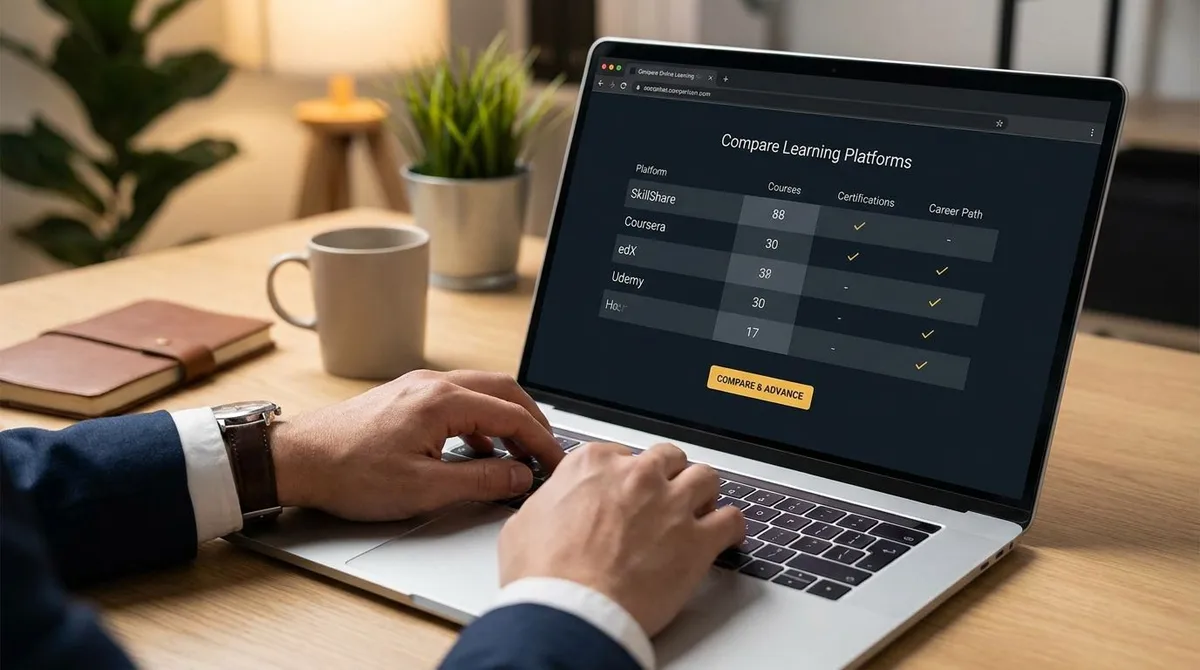
Online learning platforms give you a faster way to build job-ready skills, strengthen your resume, and stay useful in a market that rewards continuous learning. The strongest options do not all serve the same purpose, which is why choosing the right platform matters as much as choosing the right course.
This guide breaks down five leading platforms that stand out for professional development: Coursera, LinkedIn Learning, Udemy, edX, and Pluralsight. You will see where each one fits, who gets the most value from it, and how to match your learning budget, time, and career goals to the platform that can move you forward.
1. Coursera
Coursera earns its place near the top of any serious professional learning list because it blends structure, brand recognition, and breadth. If you want more than scattered tutorials, this platform gives you guided learning through certificate tracks, specializations, and full programs from universities and major employers. That structure matters when your goal is promotion, role change, or proof that you finished something substantial rather than sampled a few videos and moved on.
You also benefit from scale. Coursera has reported a very large global learner base and hundreds of academic and industry partners, which helps explain why its catalog covers business, data analytics, artificial intelligence, project management, information technology, marketing, and leadership at a depth many competitors cannot match. When a platform has this kind of partner network, you usually get more consistent curriculum design and stronger alignment with real job categories.
For professionals, the biggest strength is credibility. Hiring managers do not treat every online course the same way, and a structured program from a recognized university or employer usually carries more weight than a random tutorial series. If you need a learning path you can add to your resume, discuss in interviews, and connect to a practical career story, Coursera is one of the safer choices available.
Cost sits above many marketplace platforms, but the value improves when you plan to complete multiple courses in one year. The subscription model makes more sense for learners who will use the platform regularly, not for someone who wants one isolated course and nothing else. If you are disciplined and goal-driven, that pricing model can work in your favor because it pushes you to move through a full program rather than drift between unrelated topics.
Coursera also suits professionals who want guided progression instead of endless browsing. Too many learners lose momentum when platforms offer huge libraries without a clear route from beginner to employable skill. Coursera reduces that friction by organizing content into sequences, certificates, and tracks tied to real roles.
If your target is recognized credentials, career mobility, or a more formal learning experience without committing to a full campus program, Coursera is one of the strongest picks on this list. It works best when you already know the role or skill area you want to build and you want proof of completion that feels substantial.
2. LinkedIn Learning
LinkedIn Learning is built for professionals who want practical skill development that fits into a busy workweek. Its advantage is not academic prestige. Its advantage is relevance to day-to-day office work, management responsibilities, communication, software use, and the kind of business skills that improve performance fast.
If your job demands better presentation skills, spreadsheet fluency, project coordination, leadership habits, or stronger use of common workplace tools, LinkedIn Learning is often easier to apply immediately than a more formal platform. You can move through shorter lessons, skill paths, and role-aligned recommendations without feeling like you signed up for a semester-long academic commitment.
Another reason it performs well for working professionals is the connection to LinkedIn’s broader career ecosystem. Learning activity can connect to your profile, certificates of completion are easy to display, and the platform is designed around the language of jobs, roles, and career progression. That does not make every certificate a major credential, but it does give your learning visible placement where recruiters and employers already spend time.
The content library is large, and the platform has invested in curated pathways and role guidance. That helps when you want direction without being pushed into a full certification stack. A manager can sharpen leadership, a marketer can build campaign analysis skills, and an analyst can tighten spreadsheet and reporting ability, all without leaving the same platform.
Subscription access also supports frequent, low-friction use. If you are the kind of learner who benefits from short sessions before work, during lunch, or between meetings, LinkedIn Learning fits that behavior well. It supports steady progress, which is often more useful for career growth than binge-learning one weekend and disappearing for three months.
Choose LinkedIn Learning when your main objective is immediate workplace performance. It is especially strong for business professionals, team leads, new managers, administrative specialists, marketers, sales professionals, and anyone who wants current skills in familiar business tools without paying for a long, formal credential path.
3. Udemy
Udemy stands out for practical, affordable learning at huge scale. Its main appeal is range. You can find courses on programming, design, spreadsheet modeling, public speaking, digital marketing, cloud platforms, productivity tools, accounting software, and a long list of other job skills without paying premium university-style prices.
That breadth makes Udemy one of the best options when your need is specific and tactical. If you want to learn Power BI, Python, search engine optimization, financial modeling, graphic design, or certification prep, there is a strong chance Udemy has several courses on it. This is useful when your career growth depends on one clear skill gap rather than a full credential track.
The platform also works well for self-directed learners who know how to judge course quality. Since Udemy functions more like a marketplace, course quality varies more than on tightly curated platforms. That means you need to check instructor reputation, ratings, curriculum depth, reviews, and course recency before buying or subscribing.
For many professionals, that tradeoff is worth it. You get speed, affordability, and choice. You can jump directly into a narrow skill area and start applying what you learn at work much faster than you could in a more formal academic program. If your manager wants you to learn a new dashboard tool this month, Udemy is often a better fit than a certificate path that takes several months.
Udemy has also expanded beyond passive video learning by including practice tools, exercises, labs, and test preparation in parts of its catalog. That shift matters because professionals need output, not just exposure. Watching content is not enough. You need repetition, application, and measurable progress.
Use Udemy when you want targeted skills, low entry cost, and fast practical value. It is especially effective for learners who can evaluate instructors carefully and who prefer building skills one problem at a time instead of enrolling in a formal program with a fixed progression.
4. edX
edX remains one of the strongest names in university-backed online learning. If your standard for quality leans toward academic rigor, verified certificates, and institution-linked programs, this platform deserves close attention. It serves professionals who want learning that feels closer to formal education than to open marketplace browsing.
One of edX’s strongest advantages is the ability to audit many courses before paying for a certificate track. That lowers the risk when you want to test the material, teaching style, and level of difficulty before committing money. It also appeals to professionals who care more about knowledge than badges, at least in the early phase of skill development.
Where edX becomes more attractive is in its stackable credentials and higher-value learning options. It offers professional certificates and other structured programs that give you a clearer route from foundational learning to more advanced proof of competence. If you want resume-ready education with university association, edX can offer more seriousness than many lower-cost alternatives.
This platform works best for learners who value depth, academic standards, and more formal assessment. If you are studying data science, computer science, business, engineering, or other fields where employers respect institutional alignment, edX may feel more substantial than lighter workplace training libraries. The experience is less casual, which can be a strength when your goals are serious.
The tradeoff is cost at the premium end of some offerings. Once you move from free auditing into verified certificates or advanced technical credentials, prices can rise well beyond what casual learners expect. That means edX is not the automatic budget pick, even if it lets you begin with free course access.
Choose edX when you want institution-backed learning, stronger academic structure, and credentials that feel closer to formal education. It is a strong fit for professionals preparing for deeper role shifts, technical advancement, or resume upgrades that benefit from university association.
5. Pluralsight
Pluralsight is the specialist option on this list, and that specialization is exactly why it matters. If your work sits in software development, cloud computing, cybersecurity, information technology operations, or systems administration, Pluralsight offers a level of technical focus that general platforms often cannot match.
The biggest advantage is hands-on skill building. Technical professionals do not just need lectures. They need guided practice, skills assessments, learning paths, labs, and measurable progression tied to tools and platforms used on the job. Pluralsight has built much of its identity around that need.
This makes it especially useful when you are preparing for technical certifications, building cloud platform ability, improving coding depth, or closing a very specific technical gap. Video content alone rarely solves those problems. Practice environments, assessments, and role-based pathways create stronger learning retention and better job application.
Pluralsight also helps technical learners reduce guesswork. Many developers and information technology professionals waste time moving between random tutorials with no clear plan. A specialist platform can organize content more effectively and show you where your current level stands, what skills connect to your role, and where to focus next.
Its narrower scope is worth noting. This is not the strongest platform for general leadership, communication, sales, or administrative upskilling. Its value is greatest when your job depends on technical depth and current tooling. If you are in cloud engineering, software delivery, security operations, data infrastructure, or similar fields, that focus becomes a major advantage rather than a limitation.
Choose Pluralsight when your professional growth depends on technical execution, certification readiness, and practical labs. It is one of the best options for technology professionals who need to build real capability, not just collect course completions.
How To Choose The Right Platform For Your Career Goals
The best online learning platform is the one that matches the result you need. If you want a credential with stronger name recognition, lean toward Coursera or edX. If you need practical workplace skills you can apply this week, LinkedIn Learning makes more sense. If you want affordable tactical training, Udemy is often the fastest route. If your role is technical and requires practice environments, Pluralsight is the better call.
Start by defining the exact outcome you want. Promotion, role change, certification prep, software mastery, management readiness, and portfolio building each require a different kind of learning experience. A vague goal leads to wasted subscriptions, unfinished courses, and weak return on time.
You also need to judge your learning style honestly. Some professionals need structure and deadlines. Others perform better with self-paced, narrow, skill-based training. A platform can be excellent and still fail you if its format does not match the way you finish work.
Budget matters, but price alone should not control the decision. A lower-cost course that does not move your career is more expensive than a premium program that helps you win a raise, land interviews, or perform at a higher level. Measure value by outcomes, not just subscription cost.
Look at the full learning environment, not just the homepage claim. Check whether the platform offers projects, practice tests, labs, assessments, downloadable certificates, curated paths, or mentor-style structure. Those details shape your odds of finishing and applying what you learn.
When you choose with a defined target, the platform becomes a tool for career movement rather than another tab you never return to. That shift alone separates productive upskilling from passive course collecting.
What Actually Makes An Online Learning Platform Worth Paying For?
A platform becomes worth paying for when it saves time, improves skill transfer, and supports a result you can measure at work. The strongest platforms do not just host content. They organize learning into a useful experience that helps you move from interest to execution.
Content quality is the first filter, but structure is close behind. Plenty of platforms offer thousands of courses. Far fewer help you connect those courses to a role, a promotion path, a certification, or a real job responsibility. If the learning path is messy, completion rates fall and momentum disappears.
Practical reinforcement matters just as much as presentation. Assessments, labs, assignments, projects, and certification prep create stronger retention than passive watching alone. If your goal is professional performance, your learning process needs application built into it.
Credibility also matters. University partners, employer-backed programs, known instructors, and trusted industry brands all add value when you want to present your learning to a manager or hiring team. The stronger the source, the easier it is to explain why your coursework deserves attention.
Support for repeated use is another factor. Professionals rarely need one skill forever. A worthwhile platform gives you room to build one capability, then move to the next without starting your research from zero every time. That makes subscription models more useful when you treat learning as part of career maintenance.
If a platform offers current material, clear pathways, practical training, and visible proof of progress, it earns its cost. If it gives you a giant library with no direction and little application, the lower price will not save it.
Which Online Learning Platform Is Best For Professional Skills?
- Coursera: Best for structured credentials and career-focused programs.
- LinkedIn Learning: Best for workplace skills and short professional courses.
- Udemy: Best for affordable practical training in specific skills.
- edX: Best for university-backed learning and verified certificates.
- Pluralsight: Best for technology, cloud, cybersecurity, and hands-on technical practice.
Choose The Platform That Moves Your Career Forward
If you want stronger professional skills, the smartest move is not joining every platform. It is selecting the one that fits your role, your target outcome, and the way you actually learn. Coursera works best when you need structure and stronger credential value, LinkedIn Learning fits fast workplace improvement, Udemy delivers affordable practical skills, edX supports institution-backed advancement, and Pluralsight serves technical depth with practice built in. Once you match the platform to the result, your learning gets sharper and your time investment starts paying back in performance, confidence, and career options. Stay focused, finish what you start, and use every course as a lever for measurable progress.
References
- https://careers.quora.com/
- https://www.reddit.com/r/onlinecourses/comments/1qrvatv/which_online_learning_platforms_is_best_for_real/
- https://investor.coursera.com/news/news-details/2026/Coursera-Reports-Fourth-Quarter-and-Full-Year-2025-Financial-Results/default.aspx
- https://www.coursera.org/courseraplus
- https://www.linkedin.com/learning/
- https://www.linkedin.com/help/billing/answer/a700791?lang=en-US&utm_source=openai
- https://www.udemy.com/personal-plan/
- https://business.udemy.com/plans/
- https://www.edx.org/verified-certificate
- https://www.edx.org/technical-microcredentials
- https://www.pluralsight.com/product/labs
- https://www.pluralsight.com/individuals/pricing
- https://www.reddit.com/r/careeradvice/comments/1rqfcmd/are_online_learning_platforms_really_useful/
Originally published May 16, 2026. This article preserves its original text and byline from the website archive. Read time-sensitive statements in their publication context.
Suggest a correction